I'm considering this a crossover post as I've recently dusted off my other blog, chronicling each card in the wonderful 1956 Topps set. I hope to maintain a regular posting schedule and today's post features former Phillies player Pedro Ramos. Please click on over there for all of the posts to date, including a look at all the Phillies Alumni featured in the set.
Pedro Ramos
Washington Nationals
Pitcher
Bats: Both
Throws: Right
Height: 6'0"
Weight: 175
Born: April 28, 1935, Pinar del Rio, Cuba
Signed: Signed by the Washington Senators as an amateur free agent before 1953 season
Major League Teams: Washington Senators 1955-1960; Minnesota Twins 1961; Cleveland Indians 1962-1964; New York Yankees 1964-1966; Philadelphia Phillies 1967; Pittsburgh Pirates 1969; Cincinnati Reds 1969; Washington Senators 1970
Playing for some awful Senators teams in the mid to late 1950s, Pedro Ramos held the dubious distinction in often leading the American League in losses, hits allowed, and home runs allowed. He reached the 200-innings pitched plateau six years in a row between 1957 and 1962 and was an All-Star for the Senators in 1959. Playing in parts of 15 seasons, Ramos was primarily a starter the first part of his career, but then he switched to full time relieving and occasional closing. He was a crucial member of the Yankees bullpen late in the 1964 season, acquired in a September deal with the Indians. In his 13 appearances that September with the Yankees, he saved eight games, helping the team clinch the American League pennant. As the Yankees closer in 1965, Ramos appeared in 65 games and recorded 18 saves.
He was the last pitcher to start a game for the old Washington Senators in 1960, and the first to start a game in 1961 after the team had relocated to Minnesota and re-branded themselves as the Twins. As a batter, he accumulated 15 career home runs and owned two multi-home run games.
Building the Set
Summer of 1983 or 1984 in Millville, NJ - Card #2
It's been over three years since this story was told in post for Chuck Diering's (#19) card, so I'll repeat myself here. This Ramos card was one of the Original 44.
Technically speaking, my Dad and I actually began collecting the set in the summer of 1987, but this card (along with the other Original 44) first entered my collection three or four years before that.
I think it was either the summer of 1983 or 1984 when a shoebox of vintage baseball cards, football cards and a few non-sports cards arrived into my world. The box contained about a hundred cards dating between 1950 and 1956, and for the most part, they were all in excellent shape. A friend of the family was in the process of cleaning up and moving into her new house when she found the old shoebox and she wondered if the only kid she knew who collected baseball cards (me) would be interested in looking through it – maybe even taking the box off her hands.

She dropped the box off to my parents and asked them to have me look through the box and take what I was interested in. Turns out, I was interested in everything. Up to that point, the oldest cards in my collection were cards from the early '70s I had obtained through trades or cards that my Dad had picked up for me at yard sales or small baseball card shows. (My Dad had given me a few dog-earred ’59 Topps cards – Juan Pizzaro and Jim Busby – a few years prior, and I completely forget how or why he had purchased these cards for me.)
My parents asked me to pick out a few cards from the box, and then we’d return the rest to the family friend. Problem was, I wanted them all. I
really wanted them all. I diligently and meticulously went through one of my price guides and determined the “value” of the treasure chest. I probably used my
Sport Americana Baseball Card Price Guide No. 4, edited by Dr. James Beckett, and I had no way to value the football or non-sports cards. My memory is fuzzy, and I can't find the original tally, but I think I came up with the box being worth somewhere in the neighborhood of $300 to $400, which I knew my parents definitely did not have in their discretionary spending budget. But they could tell how much I wanted those cards, as I lovingly studied each and every one and handled each as if it were some long-lost artifact.
I don’t know the exact details, but I believe my Dad went back to the friend and told her we’d take the whole box, but only if she let him give her some money for it. I believe she was genuinely shocked that the box of old cardboard pictures had some value, and that someone was willing to give her cash for it. My Dad shared the list I had created showing the “book value” of the cards and he mentioned how it was going to be close to impossible to get me to pick and choose which ones I wanted. When all was said and done, the family friend, who had absolutely no intention of making money on this endeavor, walked away with (I think) something in the neighborhood of $100 for the whole lot.
 |
| Ramos' page from the 1967 Phillies Yearbook |
Within the spoils were 44 cards from the 1956 Topps set – by far the most cards from any one set. I studied them, I sorted them, and I pretty much memorized every detail of those 44 cards.
And so a few years later, in the summer of 1987 while on a family vacation, I was giddy with excitement when we came across a few ’56 Topps cards in the Walker Gallery on the main drag in Cooperstown, New York. My Dad and I studied the cards for sale and he casually asked me the question, “Why don’t we try to put together the whole set?” We bought four cards that day for $9.25. Those cards, along with the 44 from the magic shoebox, became the basis for our 1956 Topps set.
The Card
This is Ramos' rookie card and he'd go on to appear in Topps' flagship set every year through 1967. Ramos is listed as a right-handed batter on his card but he was in fact a switch hitter.
1956 Season
In his second full season, the 21-year-old Ramos went 12-10 with a 5.27 for the 7th place Senators. He appeared in 37 games, starting 18, and pitched 152 innings. On May 30th, Ramos and the Senators faced off against the powerhouse Yankees in the first game of a double header. Ramos drilled his future teammate Mickey Mantle (#135) in his first plate appearance, but in his second at-bat Mantle launched a home run that was hit so hard and so far it almost completely exited Yankee Stadium.
Phillies Career
On December 10, 1966, the Phillies acquired Ramos from the Yankees for Joe Verbanic and cash. Ramos was used sparingly in late April and throughout the month of May, appearing in six games and tallying eight innings pitched. The Phillies lost all six games in which he appeared. On June 5, 1967, Ramos and his 9.00 ERA were released and he spent the remainder of the 1967 season pitching in Vancouver for the Kansas City Athletics' Triple-A team. Still, his short stint with the club earned him a Phillies card in the 1967 Topps set and I've included his page from the team's 1967 Yearbook above.
 |
| 1957 Topps #326 |
|
 |
| 1959 Topps #78 |
|
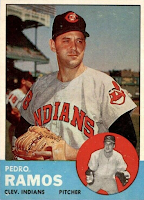 |
| 1963 Topps #14 |
|
 |
| 1966 Topps #439 |
|
 |
| 1967 Topps #187 |
|
Other Notable Baseball Cards
First Mainstream Card: 1956 Topps #49
First Topps Card: 1956 Topps #49
Representative Phillies Card: 1967 Topps #187
Last Topps Card: 1967 Topps #187
Most Recent Mainstream Card: 1978 TCMA The 1960s I #38
59 - Ramos non-parallel baseball cards in the Beckett online database as of 4/14/19.
Sources:
Baseball Reference
Beckett Database
The Phillies Room
SABR
The Trading Card Database
In some cases, the first and last cards listed above are subjective and chosen by me if multiple cards were released within the same year. Most recent mainstream card may also be subjective and does not include extremely low serial numbered cards, buybacks or cut autograph cards.


